Ebook Superforecasting: The Art and Science of Prediction, by Dan Gardner
In getting this Superforecasting: The Art And Science Of Prediction, By Dan Gardner, you may not constantly pass strolling or riding your electric motors to guide stores. Obtain the queuing, under the rainfall or hot light, and also still look for the unidentified publication to be because publication shop. By visiting this web page, you can only look for the Superforecasting: The Art And Science Of Prediction, By Dan Gardner and you could locate it. So now, this time is for you to opt for the download web link and purchase Superforecasting: The Art And Science Of Prediction, By Dan Gardner as your own soft documents book. You can read this book Superforecasting: The Art And Science Of Prediction, By Dan Gardner in soft documents just as well as save it as yours. So, you do not should hurriedly put the book Superforecasting: The Art And Science Of Prediction, By Dan Gardner right into your bag almost everywhere.
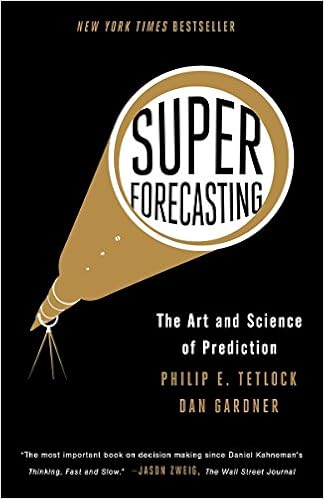
Superforecasting: The Art and Science of Prediction, by Dan Gardner

Ebook Superforecasting: The Art and Science of Prediction, by Dan Gardner
When I'm desired to review something, I intend to search for at particular book. And now, I'm still perplexed of what kind of publication that could aid me make wish of this time. Do you really feel the exact same? Wait, can everyone inform me exactly what to decide to entertain my lonesome as well as spare time? What kind of publication is actually suggested? Such a challenging thing, this is what you and also I probably really feel when having much more spare time and also have no concept to check out.
Feeling so eased to locate and wait this book finally comes appear. It is the suggested enough for you who are still confused to obtain brand-new analysis publication. When various other books included the indication of best seller, this publication is more than it. This is not just concerning the best vendor one. Superforecasting: The Art And Science Of Prediction, By Dan Gardner is one publication that will certainly make you come to be ideal person, minimally the much better individual after obtaining the lesson. The lesson of this book is commonly as just what you should do.
By soft documents of the publication Superforecasting: The Art And Science Of Prediction, By Dan Gardner to read, you may not should bring the thick prints everywhere you go. Whenever you have going to review Superforecasting: The Art And Science Of Prediction, By Dan Gardner, you can open your gizmo to review this book Superforecasting: The Art And Science Of Prediction, By Dan Gardner in soft file system. So very easy as well as fast! Checking out the soft file e-book Superforecasting: The Art And Science Of Prediction, By Dan Gardner will give you simple means to check out. It can also be quicker since you could read your e-book Superforecasting: The Art And Science Of Prediction, By Dan Gardner everywhere you desire. This on-line Superforecasting: The Art And Science Of Prediction, By Dan Gardner can be a referred publication that you could take pleasure in the remedy of life.
Yeah, the web content of this publication features easy words, very easy language designs, and also very easy feeling to comprehend. When you have located this advised book to check out, one to do is just by checking it in the link and get it. You need to start immediately because there are likewise many individuals that have obtained as well as read Superforecasting: The Art And Science Of Prediction, By Dan Gardner So, you will certainly not be left back to understand even more about this book web content.
Product details
Paperback: 352 pages
Publisher: Broadway Books; Reprint edition (September 13, 2016)
Language: English
ISBN-10: 9780804136716
ISBN-13: 978-0804136716
ASIN: 0804136718
Product Dimensions:
5.2 x 0.7 x 8 inches
Shipping Weight: 8.8 ounces (View shipping rates and policies)
Average Customer Review:
4.2 out of 5 stars
314 customer reviews
Amazon Best Sellers Rank:
#13,224 in Books (See Top 100 in Books)
Super Forecasting: The Art and Science of Prediction by Philip E. Tetlock and Dan Gardner is a rather timely book about polls, statistics, politics, news, media, and more. This book delves into how the pollsters and surveys make their predictions and how they disseminate their findings to the public.The 2016 presidential election is one in which the pollsters seem to have royally screwed up. It seems that no major survey or poll predicted the outcome that occurred. This book sheds some insight into how so many seemingly scientific polls could have been wrong all at the same time.This book is written in a way that anybody can understand, no Master's degree in statistics or math needed. It was well-written and explains that forecasters are fallible too.This book also provides guidance on how statisticians and forecasters can get better results. This sort of 10 step program (there are 11 steps) can be applied to other issues in life as well. This book is also extensively annotated, with references at the end for those looking for more technical details.I received a free copy of this book from the publisher.
There are two kind of pop-science books; one deep and thoughtful based on years of research, one quick and dirty written by a ghost-writer. This book is of the latter kind. Tetlock wrote Expert Political Judgment: How Good Is It? How Can We Know? about a decade ago. That book was deep and thoughtful. I had expected his new book to be an update with ten more years of research and consulting. Sadly, I am greatly disappointed. The book could have been written totally without additional research input. It starts with a couple of chapters of the history of the standard controlled experiment. There is about 50 pages of real content in the 330 pages of the book.There is a lot of content directly lifted from the web (e.g. Fermi-forecasting, Auftragstaktik) - kind of Malcolm Gladwell style, some insight and some misinterpretation.The style is **extreme pop-science**. What do I mean with that? Far too many pages, plentiful descriptions of minute irrelevant details of individuals (so called human interest points - I guess that is what they teach in creative writing), never any figure or number (e.g. 67% is changed to two thirds), all difficult material removed or put in a footnote. And how come a book with two authors use the pronoun "I" all the time?The researcher has run a forecasting tournament for several years. He has loads of data, but he does not provide any analysis in the book. He refers to his research in footnotes, but no explanation or description at all. Instead we get statements like 80% of superforecasters are more intelligent than average. What is wrong with running a regression to find out what characteristics are important? Why spend five chapters going through the characteristics of superforecasters? In the end, apparently, two characteristics stand out. (1) Continual updating of forecasts, (2) Being intelligent. That fact is told after around 200 pages of tedious writing. Wtf? I can reluctantly accept dumbing down the book, but it is inexcusable that the footnotes does not include some further help to the reader that wants more depth.The author likes to give minute details of the superforcasters. Personally, I don't care that Brian likes Facebook updates of cats, that John is retired because he is sick and that he now likes to collect stuff or that Steve is and old colleague of the author that likes opera. Who reads and enjoy this written muzak? It goes on chapter after chapter. We "meet" 15-20 superforecasters.There is a lot about the superforecasters in the book, but the title of the book is "Superforecasting". This is a seriously misleading title. It makes you believe that you will learn tools to become a great forecaster. You get some, mostly general, points in an eight page appendix. With the researcher's experience, I would have expected a lot of practical advice.What is good about the book?(1) The key message that experts are lousy forecasters and do not want accountability is very important, but that was already in the author's earlier book.(2) Some useful anecdotes that you probably should pick up if you are teaching/presenting on the topic.(3) Odd bits of information. I liked the discussion of how the German military used what we consider modern management already 100 years ago. As mentioned earlier, there are 50 pages of really good material in the book.I bought the hard-cover edition. If you make notes with a normal pencil, be careful because it easily pierces the paper.The book is worth two stars. If you are en educator and want a few anecdotes, read the book. Others should give it a pass. Instead sign up to the author's forecasting tournament. You learn more by trial and error learning. I signed up two years ago and it is a useful experience. You can also check the video features on edge.org. Then spend time reading better books. A few rigorous pop-science books:* Another forecasting perspective is Steenbarger's Trading Psychology 2.0: From Best Practices to Best Processes (Wiley Trading). It is about trading in the market, but it covers many of the topics from a different perspective. Worth reading his earlier books too.* And if you haven't read Thinking, Fast and Slow, that is a more important book (but also too fluffy for my linking).* You should also read Taleb's The Black Swan: Second Edition: The Impact of the Highly Improbable: With a new section: "On Robustness and Fragility" (Incerto), but don't buy his fluffy version of the same topic Fooled by Randomness: The Hidden Role of Chance in Life and in the Markets (Incerto)
The book offers insights into one of the most important aspects of professional performance, being able to predict the outcome of future events - which is of course impossible in most cases. The book does, however, come with very valuable insights - and unless you are familiar with these already - could make you a better forecaster.The key points I found from this book is to force yourselves to explicitly state your forecast, preferably in numerical probability, so that you can easily judge and learn from them when the facts are given. Keep an open mind (ridiculously obvious?). Separate known statistical content from case specific guess work - ie what is general in a case and what needs specific analysis?Although the information provided might be very useful, and I do not regret the read - I think the text is far too verbose and much of the content either repetitive or not very interesting. I kept thinking about Nassim Nicholas Taleb's entertaining books on randomness when reading, until his name appeared in an endless chapter on the critics of the author's work. If you haven't read Taleb's books, read them first - and save this one to your retirement days.
I (Matt) have really enjoyed reading Super Forcasting: The Art and Science of Prediction by Phillip E. Tetlock and Dan Gardner. It's a fun book for taking a dive into forecasting .I enjoyed reading about how forecasters related to weather, politics, stocks, etc. are often considered professionals even though they may actually be amateurs. I also liked learning about how even though these people are often very bad or unreliable at forecasting, it is in many ways a skill that can be learned. While it definitely leans more towards pop-science than going academically deep into the presented topic, I feel like I learned some new information from this book.I do wish there was less fluff and I often found myself wishing for deeper analysis of the years of research the authors kept referencing.If you enjoy books like Moneyball or Freakonomics then I would recommend this book to you.**I received this book from Blogging for Books for free.**
Superforecasting: The Art and Science of Prediction, by Dan Gardner PDF
Superforecasting: The Art and Science of Prediction, by Dan Gardner EPub
Superforecasting: The Art and Science of Prediction, by Dan Gardner Doc
Superforecasting: The Art and Science of Prediction, by Dan Gardner iBooks
Superforecasting: The Art and Science of Prediction, by Dan Gardner rtf
Superforecasting: The Art and Science of Prediction, by Dan Gardner Mobipocket
Superforecasting: The Art and Science of Prediction, by Dan Gardner Kindle